How far do measurement correlations reach in a cluster state?
22 September 2026
The 1D cluster state is the workhorse of measurement-based quantum computing. Its stabilizers are \(Z_{i-1}X_iZ_{i+1}\), and in the computational basis its amplitudes are just signs:
Measure every qubit in the \(Z\) basis and you get independent, uniformly random bits. The same happens in the \(X\) basis. Tilt the measurement basis to an angle \(\theta\) somewhere in between, though, and the outcomes become correlated. For my thesis I wanted to know how far those correlations reach. The answer tells you how much memory a model needs to reproduce the distribution one site at a time, which is exactly how autoregressive neural networks such as RNNs generate samples.
Measuring “how far”
Take a block of consecutive outcomes \(X_0, X_1, \dots, X_{m+1}\). The conditional mutual information
is what the two ends still share once you know everything in between. If \(I_m\) decays like \(e^{-m/\xi}\), a model that looks back about \(\xi\) sites already captures most of the dependence.
Computing it exactly
The cluster state is a matrix product state with bond dimension 2, so there is no need to sample. Rotating each physical leg by \(R_y(\theta)\) gives one \(2\times2\) matrix \(B^x\) per outcome \(x\). The Born-rule transfer matrix is \(E = \sum_x \bar B^x \otimes B^x\), and the probability of any block follows from its dominant left and right eigenvectors. For \(m\) up to 12 I simply enumerate all \(2^{m+2}\) bitstrings; a scan over 31 angles takes about 20 seconds on a laptop.
To be sure the transfer-matrix code is right, the tests compare it with a brute-force calculation on an explicit state vector. The probabilities agree to \(10^{-12}\).
What comes out
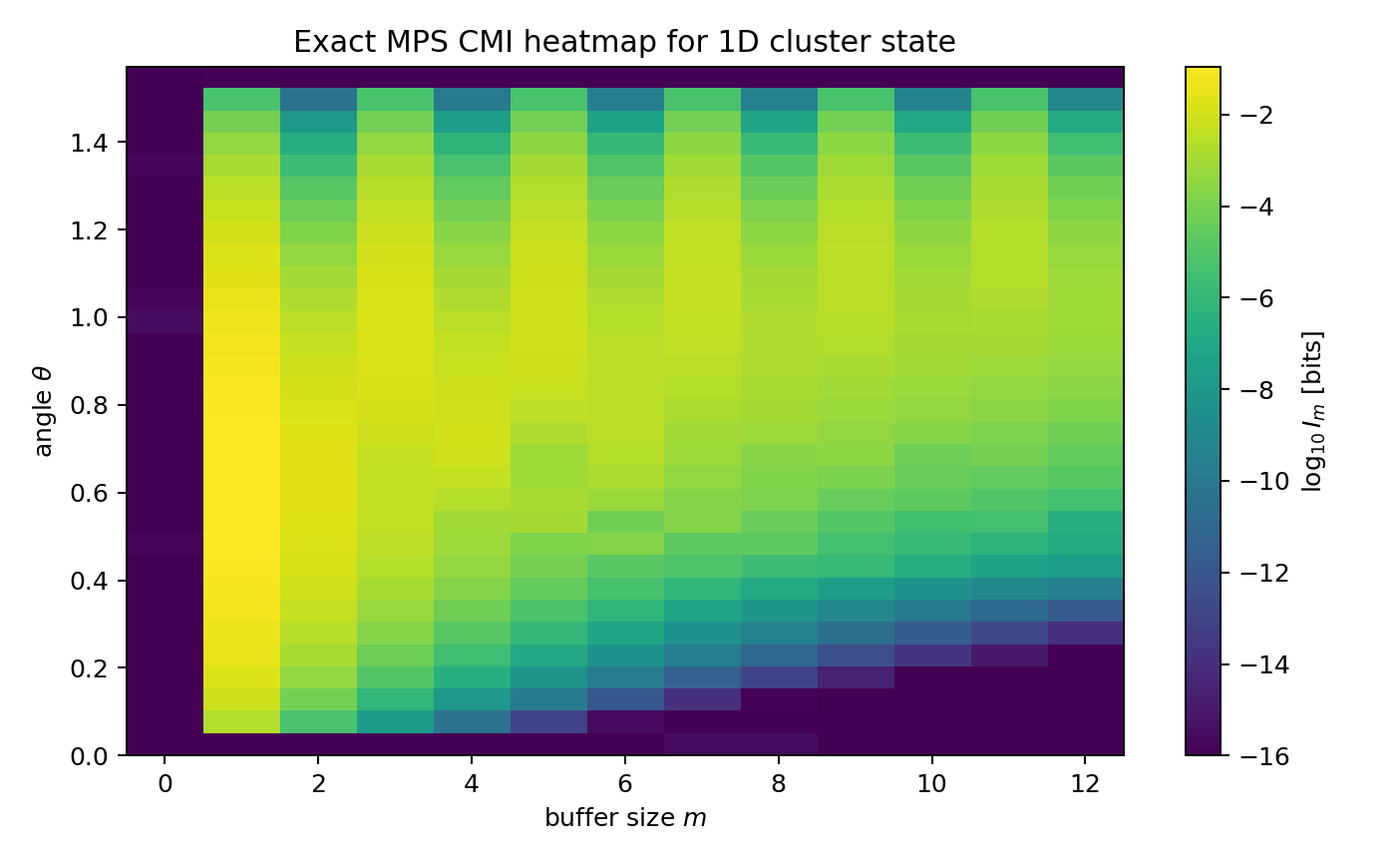
Three things stand out.
- \(I_0 = 0\) at every angle: neighbouring outcomes are always independent. Correlations only appear once there is at least one site in between.
- At small \(\theta\) the CMI drops by many orders of magnitude within a few sites. The fitted decay length grows from about 0.2 sites at \(\theta = 0.05\) to about 2 sites at \(\theta = \pi/4\), and passes 10 sites near \(\theta \approx 1.3\).
- Close to \(\pi/2\), odd and even \(m\) separate and the decay becomes very slow, until at exactly \(\pi/2\) everything vanishes again. Here a single exponential no longer describes the data, which is a good reminder to look at the raw \(I_m\) before trusting a fitted length.
Next
In the thesis I also train RBM, RNN and MPS-based models on this state and compare how easily each one learns it. That comparison is in Expressive is not the same as learnable.
The code is cluster_mps_cmi_length_scan.py in my nqs_project repository.